The pattern across seven published figures
Industrial gas is not one duty. A sand-reclamation Muller burner at 200°C, a powder-coating curing oven, an LPG process line at an auto-components plant, a spring hardening furnace at about 1,000°C, a glass tableware forming line, a ceramic spray dryer, a kiln firing ceramic fuse bases and an 800°C aluminium melt are eight different problems, and the module saves a different amount on each. Indo Shell Cast measured roughly 20% less LPG per tonne. Metsmith Innovations has held 10–15% on PNG since April 2024. MSM Spring India recorded 12% on its hardening furnace in August 2026. Borosil’s glass tableware line in Jaipur, fitted with mini modules at the burners, reports 8–10%. CUMI’s ceramic spray dryer came in at 14.6% for the first half of September 2026, against 8–10% committed. Sonya Ceramics in Ahmedabad reports 10% less PNG on the kiln that fires its ceramic fuse base insulators. The hardest duty measured so far — an 800°C aluminium melt — returns 7–8%. Samvardhana Motherson’s Pondicherry plant went from one module to four. The spread is the point: a device that returned the same headline number on every furnace would not be credible.
The number Niveda Green commits to
Niveda Green’s working figure for an industrial gas line is about 8%. That is the saving it commits to before an order, sized to the burner and the duty, and the figure it asks the plant to judge the module against — on the plant’s own gas records, over a full production cycle, not in a week. Some lines return more than the commitment: Indo Shell Cast measured roughly 20%, MSM Spring India recorded 12% on a furnace where 8% had been committed, and CUMI’s spray dryer 14.6% where 8–10% had been committed. The hardest duties return less. The commitment is what a plant buys; anything above it is the plant’s to keep, and a figure a plant reports above that band is published here only once it is on the plant’s own letterhead. That is why the numbers on this page are not the same, and why none of them is a promise about your line.
Why the smallest percentage can be the largest saving
A melting furnace burning several tonnes of gas a month at 7% saves more money than a small oven at 20%. The number that matters is not the percentage — it is the gas bill for that burner line. Tell Niveda Green the equipment, the fuel and the monthly consumption and they will work it through with you before you order.
Samvardhana Motherson — one module in December 2024, three more since
Samvardhana Motherson International is one of the world’s largest suppliers to automotive OEMs: founded in 1986, listed in India since 1993, with more than 400 facilities across 44 countries. Its plant at Thirubuvanai, Pondicherry — run by group company Samvardhana Motherson Innovative Solutions — placed a purchase order with Niveda Green for one Greentech industrial LPG saving module in December 2024, on the same terms as every other plant on this page: a saving committed for that duty before the order, then measured against the plant’s own gas consumption. A group of that size does not buy on a brochure, and it does not buy three more units on a first one that failed. The plant’s own reading on the Pondicherry line came in well above Niveda Green’s commitment; that figure is the plant’s to certify, and until it is on Motherson letterhead it is not on this page. What is on record is what the group did next — three further units for other plants — and the December 2024 purchase order, with its commercial terms withheld, in the documents panel above.
CUMI — a ceramic spray dryer, 8–10% committed, 14.6% measured
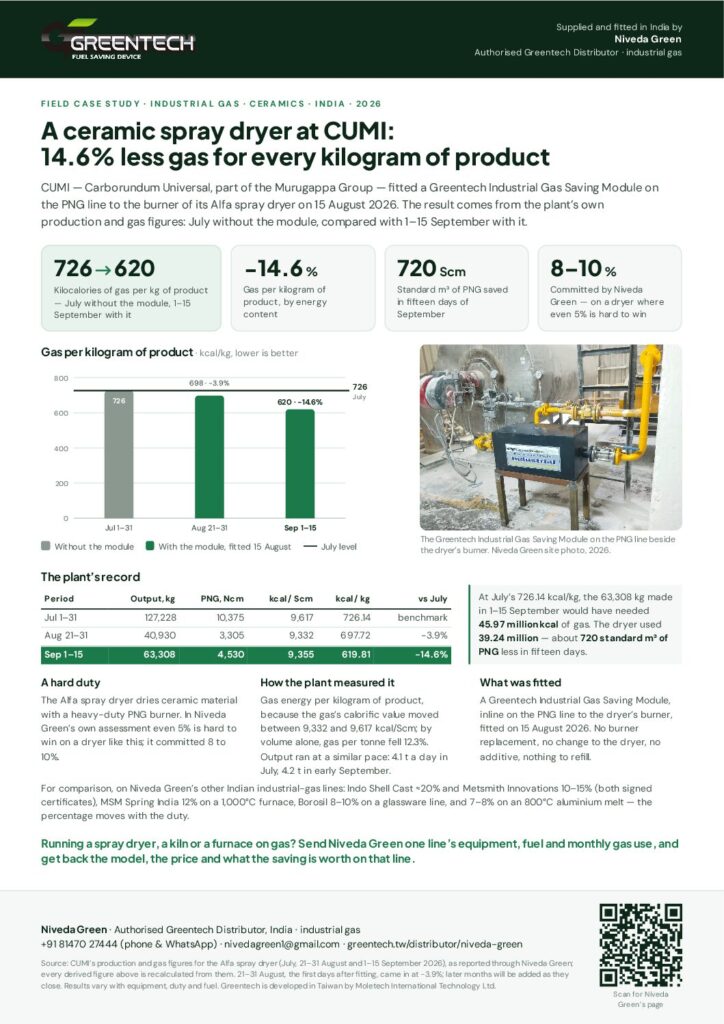
Carborundum Universal (CUMI), the Murugappa Group’s abrasives and ceramics company, founded in 1954, dries ceramic material in a spray dryer fired by a heavy-duty PNG burner. In Niveda Green’s own assessment even 5% is hard to win on a duty like this; it committed 8 to 10%. The module went onto the dryer’s gas line on 15 August 2026. The plant measures fuel as gas energy per kilogram of product, because the calorific value of its PNG varies: 726 kcal/kg in July without the module, 698 kcal/kg over 21–31 August, and 620 kcal/kg over 1–15 September — 14.6% less, at a similar output of about four tonnes a day. By gas volume alone the drop is 12.3%. The one-page CUMI case study, with the plant’s full record, is in the documents panel above, and the photographs of the module at the dryer’s burner are in the gallery.
Borosil, Jaipur — mini modules at the burners, 8–10%
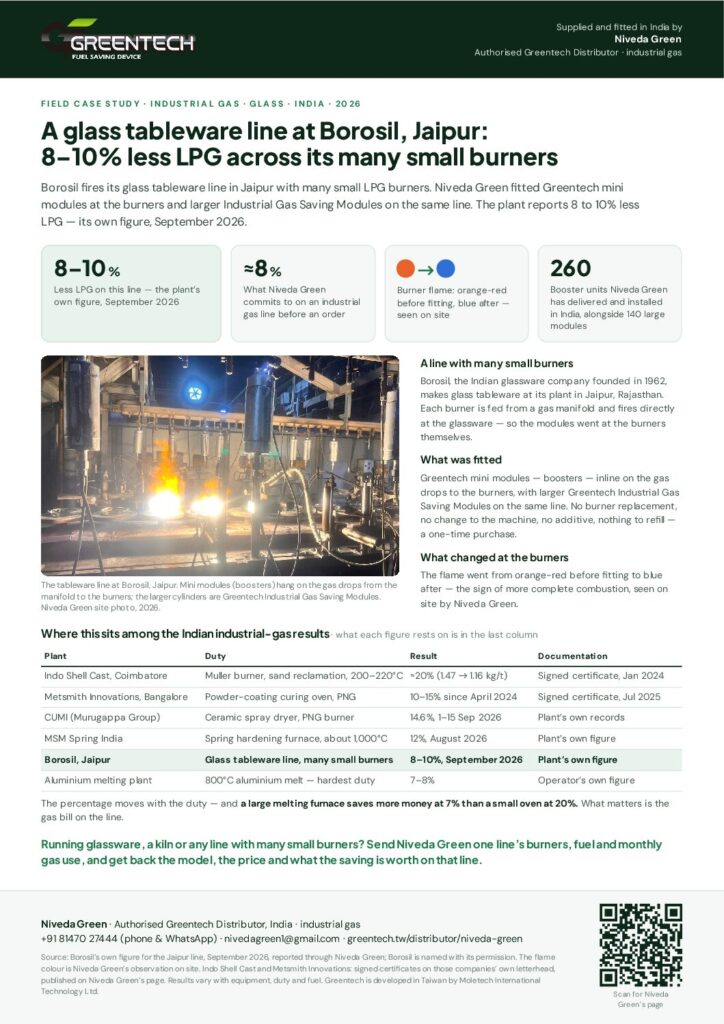
Borosil, the Indian glassware company founded in 1962, makes glass tableware at its plant in Jaipur, Rajasthan, on forming lines fed by many small burners rather than one large one. Alongside larger Greentech modules on the line, Niveda Green fitted mini gas-saving modules — boosters — at the burners themselves. Before fitting, the burners ran an orange-red flame; after fitting, a blue one — the sign of more complete combustion, observed on site by Niveda Green. The plant’s own figure is an 8–10% LPG saving, and Borosil has agreed to be named here. The one-page Borosil case study is in the documents panel above; the clip in the video section below shows the line, and the photograph of the burner deck is in the gallery.
MSM Spring India — 6% asked for, 8% committed, 12% measured
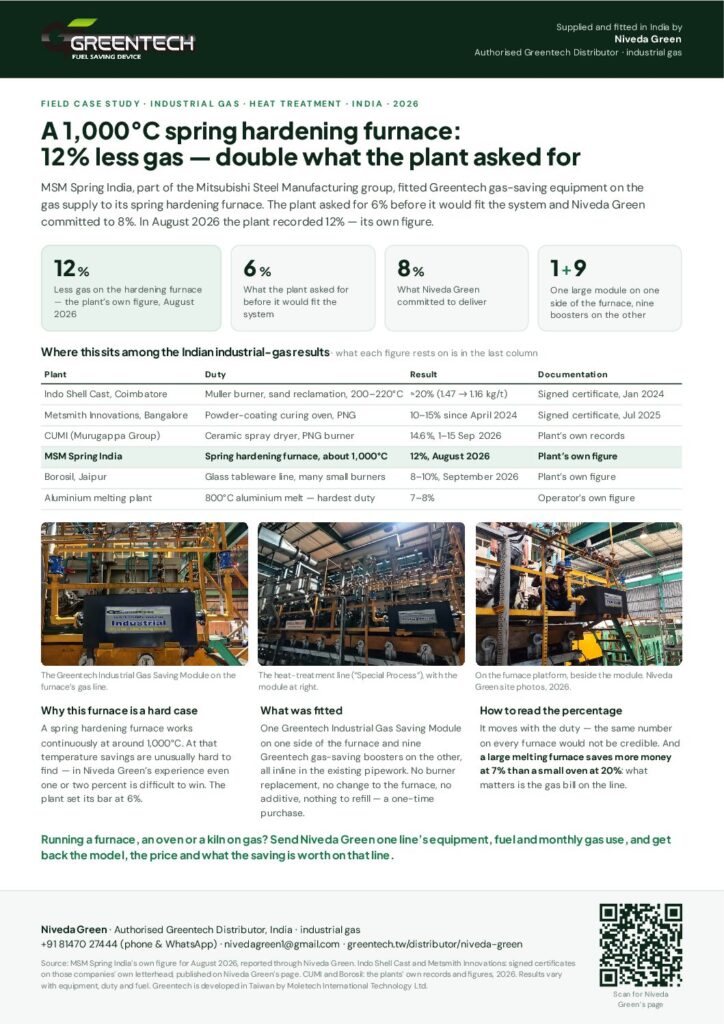
MSM Spring India is part of the Mitsubishi Steel Manufacturing group. Its spring hardening furnace runs at about 1,000°C, and Niveda Green’s own assessment is that on a furnace at that temperature even one or two percent is hard to win. Niveda Green fitted one Greentech Industrial Gas Saving Module on one side of the furnace and nine Greentech gas-saving boosters on the other, all inline on the existing gas lines. The plant set 6% as the level worth having. Niveda Green committed to 8%. The plant’s own figure for August 2026 was 12%. That number is the operator’s, not ours, and it is not yet on their letterhead — which is why the table above still marks it as the operator’s own figure. The one-page MSM Spring India case study is in the documents panel above; photographs of the module and the heat-treatment line are in the gallery, and site clips are in the video section below.
Sonya Ceramics — a PNG kiln, 10%
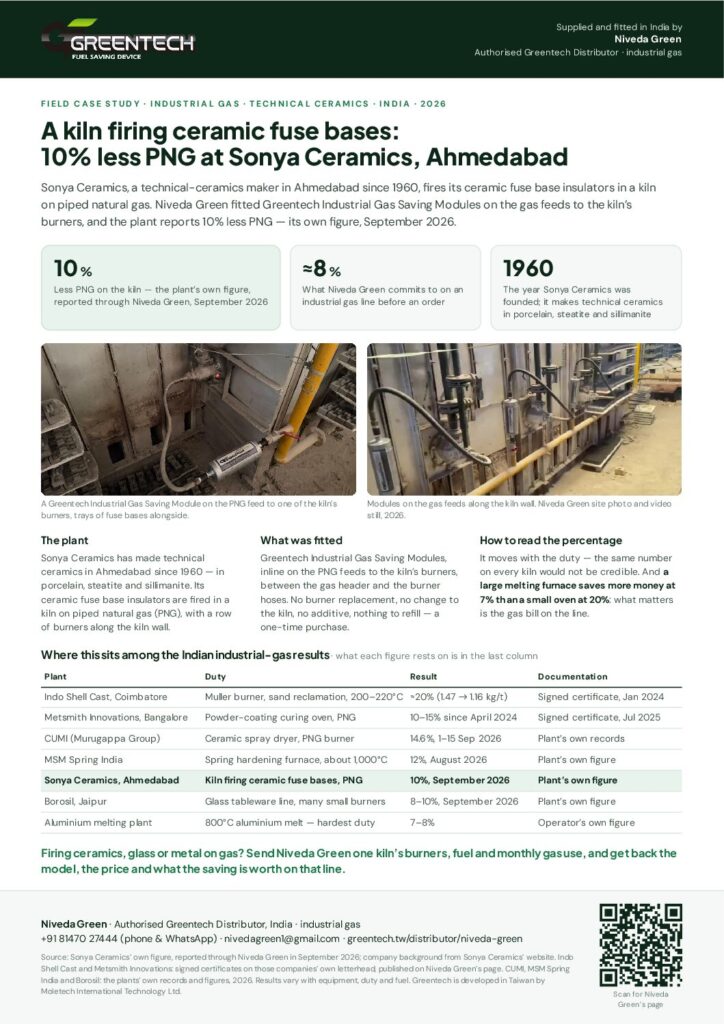
Sonya Ceramics has made technical ceramics in Ahmedabad since 1960, in porcelain, steatite and sillimanite. Its ceramic fuse base insulators are fired in a kiln on piped natural gas, with a row of burners along the kiln wall. Niveda Green fitted Greentech Industrial Gas Saving Modules on the gas feeds to the burners, between the gas header and the burner hoses. The plant reports 10% less PNG — its own figure, reported in September 2026. The one-page Sonya Ceramics case study is in the documents panel above, the photograph of a module at one of the burners is in the gallery, and the clip along the kiln wall is in the video section below.
Bühler India — installed in September 2026
Bühler India, which makes and supplies food-processing equipment, now has a large Greentech Industrial Gas Saving Module on the gas train feeding one of its burners; Niveda Green completed the installation in September 2026. There is no figure yet — it will be added when the plant has measured it. The clip is in the video section below.
Indo Shell Cast — the one with before-and-after numbers
Indo Shell Cast fitted the module to a 300 kg Muller burner in its sand reclamation plant at Malumichampatti, Coimbatore, in December 2023. The plant runs 24 hours a day, 28 to 30 days a month, so the burner is close to continuous duty. LPG consumption went from 1.47 kg per tonne to 1.16 kg per tonne, which the plant manager’s certificate records as roughly a 20% reduction. They have since ordered a larger module for the main burner. Their November 2023 purchase order for the two burner modules is in the documents panel.
Metsmith Innovations — eighteen months, no maintenance
Metsmith Innovations in Bommasandra, Bangalore runs a powder coating and curing plant supplying auto parts across the region. The module went into the curing oven’s PNG supply line in April 2024 and has given 10–15% gas savings since. Their certificate is worth reading as much for upkeep as for savings: no parts, no service and no safety issues in a year and a half, and in their own words a “fit and forget” gas saving system. They have offered to talk to other manufacturers about their experience and to host visitors at the Bangalore plant.
Purchase orders on file
A signed certificate says what a plant measured; a purchase order says what it was prepared to pay for. The documents panel above carries five purchase orders placed with Niveda Green for Greentech industrial gas saving modules: Indo Shell Cast, Unit-II, Coimbatore (November 2023, two burner modules); Unique Industry, Coimbatore (July 2024, two modules, the second released on the performance of the first); Miglani International, New Delhi (September 2024, an NG/PNG module for an end customer); Samvardhana Motherson Innovative Solutions, Pondicherry (December 2024); and ASK Automobiles, Alwar, Rajasthan (November 2025, a PNG saving system on a two-tonne aluminium melting furnace). Prices, payment terms and the savings commitments agreed with each plant are withheld, because they are different for every plant. To date Niveda Green has delivered and installed 400 modules across India — 260 booster units and 140 large modules — and 390 of them are in service.
What is documented, and what is not
The Indo Shell and Metsmith figures come from signed, dated certificates on company letterhead, published here in full, and both plants’ purchase orders are on file. The MSM Spring India, Sonya Ceramics, Borosil and aluminium-melt figures are the operators’ own reports, and CUMI’s is worked out from the plant’s own production and gas records; none of these carries a certificate yet — they are shown because they fit the pattern, not because they are certificated. Motherson’s result is not shown as a number at all: the plant’s reading is theirs to certify, and the repeat order stands on its own. Bühler India is listed as an installation only, with no figure yet. Across every published Greentech test worldwide, documented savings run from roughly 5% to 25%.
 Industrial Gas Module